What’s involved in the 25 Year Follow-Up?
Twenty five years ago you were part of something extraordinary. You may or may not remember it, but you were a participant in the National Survey of American Life, conducted by the University of Michigan. Now, 25 years later, we are returning to interview as many of the original NSAL participants as we possibly can – we are hoping to reach everyone!
You can earn up to $150 for your participation in this study.
With the follow up study, we are particularly interested in aging as a life-long process. We are studying why Black Americans face a 2-4 times higher risk of dementia compared to other groups. If we can understand what causes this difference, we can work to make changes that might help our communities. Your contributions are an essential part of this work.
Researchers will be contacting you by phone and mail to discuss your participation in this follow up. We look forward to connecting once again.

Help us reach you – Update your Contact Info
I want to understand how many of you have maintained your overall health so that I can help inform nurses and other health professionals on ways to be supportive. Hearing from you can help us improve the lives of others and future generations in important ways.
Participation Involves:

Meeting with an interviewer in your home or by telephone for about 2 hours and 20 minutes.

Answering questions about your life, your community, your health, and a variety of other topics.

Completing a Cognitive Assessment that involves a variety of brain exercises.

Physical measurements: height, weight, waist, blood pressure, and hand grip strength.

Blood Draw by a member of our blood collection team in your home.

Receiving up to $150 total
$100 for in-person interview
+ $50 for optional blood draw
OR $40 for telephone interview
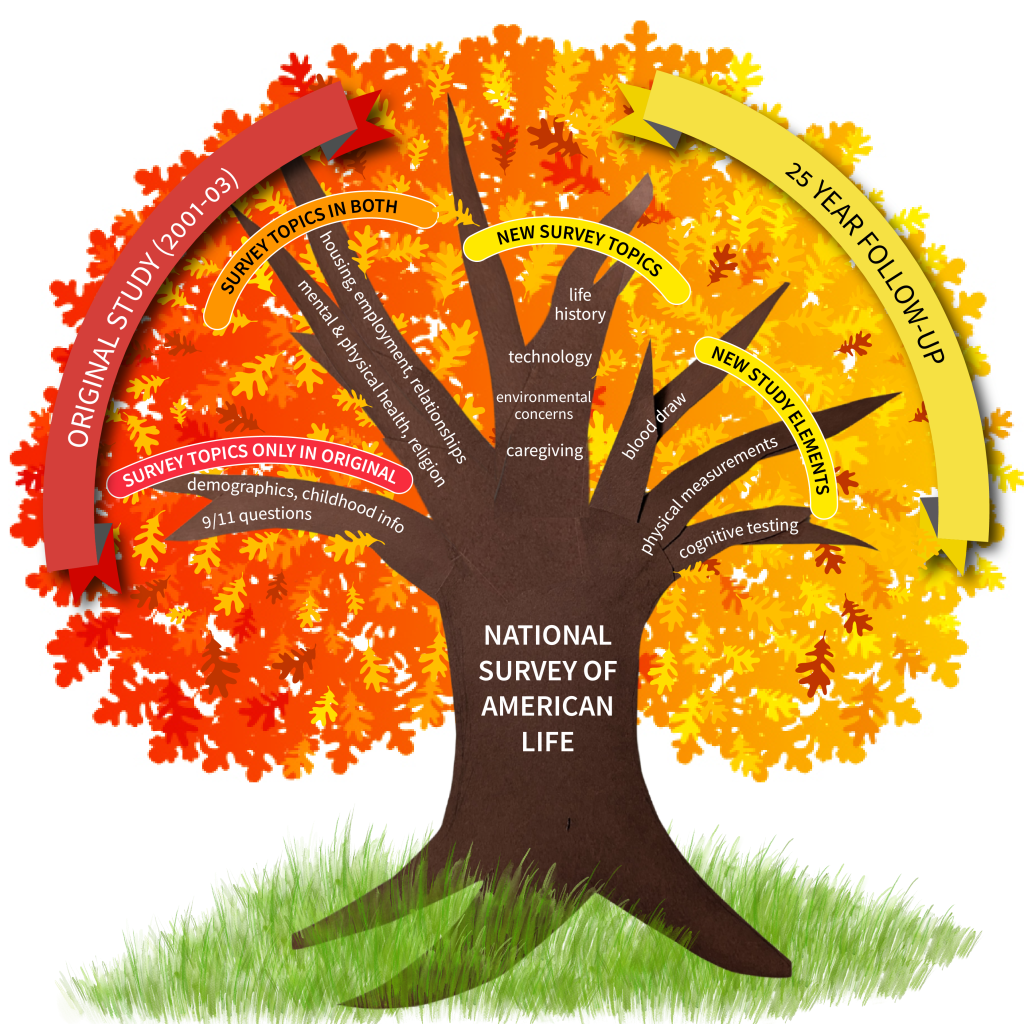 Comparing the Original Study with the 25 Year Follow-Up
Although we are talking to the same participants again, there are many changes from the original National Survey of American Life. This 25 Year Follow-Up is not just a repeat of the original study.
The interview has been re-written to include new topics and remove things we don’t need to ask about again. The science of surveys has also changed in the past twenty five years, and some questions and topics have been changed to reflect the current best practices. That said, some topics and questions haven’t changed–we are still interested in many of the same things we were before! We’re also adding entirely new elements that weren’t part of the original 2001-03 study at all, including cognitive testing, and physical measurements and an optional blood draw, and for in-person participants.